


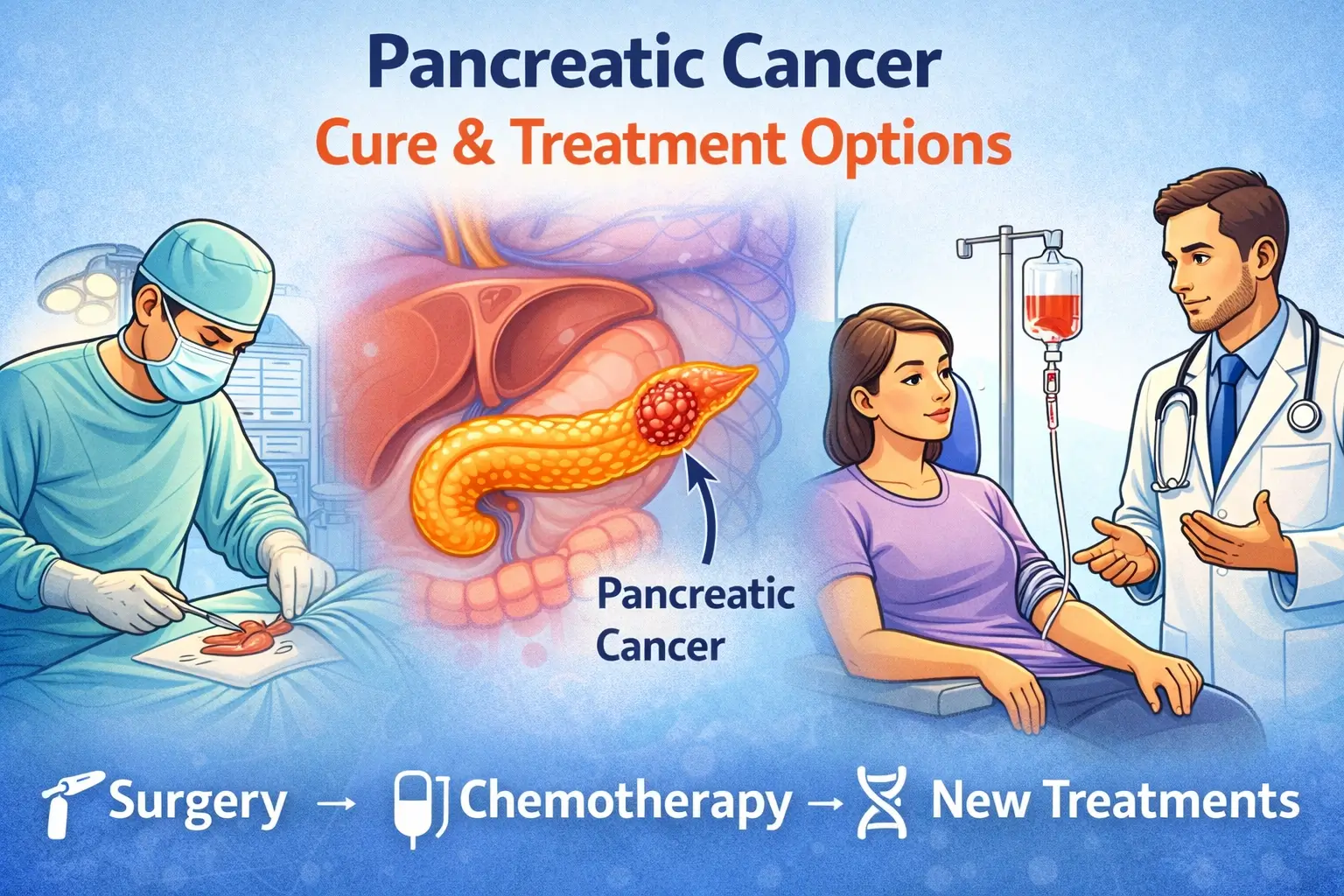
Pancreatic Cancer Cure : Latest Treatment Options, Surgery, Survival & New Research (2026)
Pancreatic cancer cure : Pancreatic cancer is one of the most challenging cancers to treat. Many people search online asking a simple but important question:
“Is pancreatic cancer curable?”
The honest medical answer is:
👉 Pancreatic cancer can sometimes be cured if it is diagnosed early and completely removed by surgery.
Pancreatic cancer cure : However, in many cases, the disease is diagnosed at a later stage, where treatment focuses on controlling the cancer, extending life, and improving quality of life rather than complete cure.
In this in-depth guide, you will learn:
-
When pancreatic cancer can be cured
-
Role of surgery (Whipple procedure and others)
-
Chemotherapy and radiation therapy
-
Targeted therapy and immunotherapy
-
Palliative care
-
Latest research and future hope
-
Survival by stage
-
Frequently asked patient questions
This article is written in simple language so patients and families can clearly understand real treatment options.
What Is Pancreatic Cancer? Pancreatic cancer cure
Pancreatic cancer develops in the pancreas, an organ located behind the stomach. The pancreas plays a key role in:
-
Digesting food (digestive enzymes)
-
Controlling blood sugar (insulin and hormones)
The most common type is pancreatic ductal adenocarcinoma (PDAC), which accounts for more than 90% of cases.
Can Pancreatic Cancer Be Cured? Pancreatic cancer cure
The Short Answer
✔️ Yes — but only in a limited number of patients.
A true cure is usually possible only when the cancer is detected early and removed completely with surgery.
Unfortunately, more than 80% of patients are diagnosed at an advanced stage, when surgery is no longer possible. In these cases, treatment is not considered curative, but it can still:
-
Slow disease progression
-
Reduce symptoms
-
Extend survival
-
Improve quality of life
Surgery: The Only Potential Cure
Why Surgery Matters
Surgery is currently the only treatment that offers a real chance of cure in pancreatic cancer. However, only about 15–20% of patients are eligible for surgery at diagnosis.
Types of Pancreatic Cancer Surgery
1. Whipple Procedure (Pancreaticoduodenectomy)
This is the most common surgery for pancreatic cancer in the head of the pancreas.
It removes:
-
Head of the pancreas
-
Part of the small intestine
-
Gallbladder
-
Part of bile duct
-
Sometimes part of the stomach
The Whipple procedure is complex but can be life-saving in early-stage disease.
2. Distal Pancreatectomy
Used when the tumor is in the body or tail of the pancreas. It removes:
-
Tail and/or body of pancreas
-
Often the spleen
3. Total Pancreatectomy
Rarely used. The entire pancreas is removed.
Neoadjuvant and Adjuvant Therapy (Before and After Surgery)
Modern treatment usually combines surgery with chemotherapy.
Neoadjuvant Therapy (Before Surgery)
Chemotherapy (sometimes with radiation) may be given before surgery to:
-
Shrink the tumor
-
Kill microscopic cancer cells
-
Improve chances of complete removal
Adjuvant Therapy (After Surgery)
After surgery, chemotherapy is commonly used to:
-
Reduce risk of recurrence
-
Kill remaining microscopic disease
This combination approach improves long-term outcomes.
Chemotherapy: Main Treatment for Most Patients
Chemotherapy uses drugs to kill cancer cells throughout the body.
Common regimens include:
-
FOLFIRINOX
-
Gemcitabine + nab-paclitaxel
-
Gemcitabine + capecitabine
Chemotherapy is used:
-
Before surgery
-
After surgery
-
As primary treatment in advanced cancer
It is a key part of almost all pancreatic cancer treatment plans.
Radiation Therapy
Radiation uses high-energy beams to destroy cancer cells.
Radiation may be used to:
-
Shrink tumors
-
Control pain
-
Treat locally advanced cancer
-
Reduce local recurrence after surgery
It is often combined with chemotherapy (chemoradiation).
Targeted Therapy
Targeted therapy focuses on specific genetic changes in cancer cells.
Some patients benefit from:
-
PARP inhibitors (for BRCA-mutated cancers)
-
KRAS-targeted drugs (in clinical trials)
-
Other molecular-based treatments
Tumor genetic testing is increasingly important to find personalized treatment options.
Immunotherapy
Immunotherapy helps the immune system recognize and attack cancer.
Currently:
-
Standard immunotherapy has limited benefit in most pancreatic cancers
-
Some patients with specific markers (like MSI-high tumors) may benefit
-
New vaccines and immune combinations are in clinical trials
Recent research is exploring cancer vaccines and immune-combination therapies, which show promise but are still experimental.
Palliative Care: Improving Quality of Life
Palliative care is not the same as giving up treatment.
It focuses on:
-
Pain control
-
Managing jaundice
-
Treating digestion problems
-
Improving appetite
-
Emotional and psychological support
Palliative care can be given alongside active cancer treatment.
Survival and Cure Rates by Stage
Survival depends strongly on the stage at diagnosis:
-
Stage I (early, resectable):
Cure possible in 30–40% after surgery + chemotherapy -
Stage II (locally advanced but operable):
Long-term survival 15–25% -
Stage III (locally advanced, not operable):
Long-term survival 5–10% -
Stage IV (metastatic):
Not considered curable, but treatment can extend life
Overall 5-year survival for all stages combined is around 12%.
New Research and Future Hope (2025–2026)
Medical research is moving fast. Promising areas include:
-
Cancer vaccines targeting KRAS mutations
-
Triple-drug combination therapies
-
Personalized mRNA vaccines
-
New targeted therapies
-
AI-based early detection tools
Some lab studies and early human trials show encouraging results, but these are not yet standard cures and are still under clinical evaluation.
When Should You See a Specialist Center?
Because pancreatic cancer is complex, experts strongly recommend:
-
Treatment at high-volume cancer centers
-
Multidisciplinary teams (surgeons, oncologists, radiologists)
-
Access to clinical trials
This can significantly improve outcomes.
Important Warning About “Natural Cures”
There is no proven natural cure for pancreatic cancer.
Herbal remedies, special diets, or alternative therapies:
❌ Cannot cure pancreatic cancer
❌ Should never replace medical treatment
Some complementary approaches may help symptoms, but always discuss with your doctor.
Frequently Asked Questions (Patient Q&A)
Can pancreatic cancer be cured completely?
Yes, but mainly in early-stage disease with successful surgery and chemotherapy.
Is Whipple surgery risky?
Yes, it is a major surgery, but in experienced centers it can be performed safely and can be life-saving.
Can stage 4 pancreatic cancer be cured?
No. Stage 4 is not considered curable, but treatment can extend life and improve comfort.
Does chemotherapy always help?
It does not cure advanced cancer, but it can slow progression and reduce symptoms.
Are there new cures coming soon?
Promising research is ongoing, including vaccines and targeted drugs, but they are still in trials.
Final Conclusion
Pancreatic cancer remains one of the most difficult cancers to treat.
👉 Surgery offers the only real chance of cure — and only for patients diagnosed early.
For many others, modern treatments can still:
-
Prolong survival
-
Reduce suffering
-
Improve quality of life
Research in 2025–2026 is bringing new hope, but early detection and expert care remain the most powerful tools today.
Pancreatic cancer cure – QnA
You can also add this quick QnA block:
Q: Can pancreatic cancer be cured?
A: Yes, in early stages, surgery combined with chemotherapy can sometimes cure pancreatic cancer.
Q: What is the best treatment for pancreatic cancer?
A: Surgery (Whipple procedure) plus chemotherapy is considered the best curative approach.
Q: Is stage 4 pancreatic cancer curable?
A: No, stage 4 is not curable, but treatment can extend life and reduce symptoms.

2 thoughts on “Pancreatic Cancer Cure: Surgery, Treatment Options & New Hope”