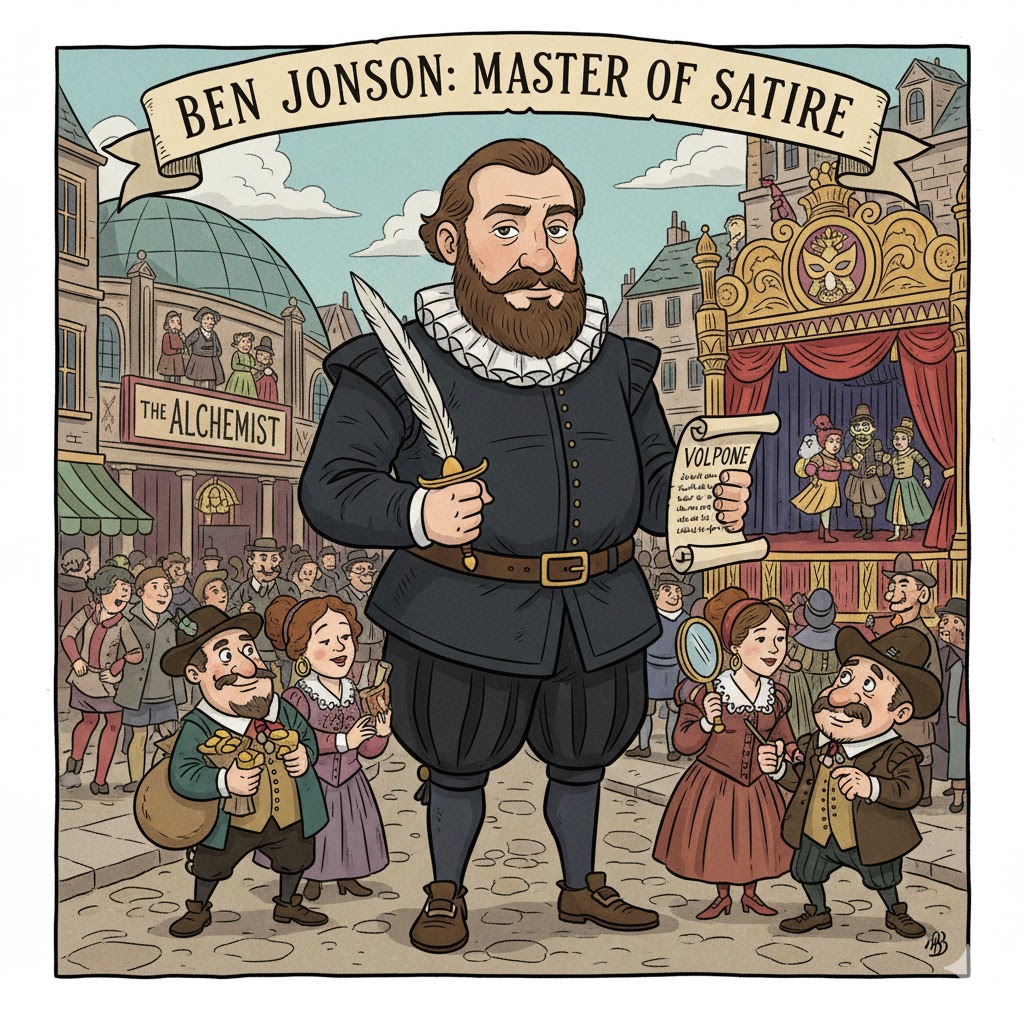
Ben Jonson Biography : The Master of Satire and Shakespeare’s Greatest Rival
Ben Jonson Biography : In the golden age of English literature, one name stands tall alongside William Shakespeare, representing the sharpest wit and the most rigorous intellect of the era. Ben Jonson (1572–1637) was not just a playwright; he was a poet, a brawler, a scholar, and the first unofficial Poet Laureate of England. While Shakespeare was known for his “wood-notes wild” and romantic imagination, Jonson was the master of “Comedy of Humours,” using his pen like a scalpel to dissect the greed, vanity, and folly of London society.
1. Early Life: From Humble Beginnings to Westminister
Ben Jonson was born in London in early 1572, under circumstances that did not suggest a future in the royal court. His father, a minister, died shortly before Ben’s birth, and his mother eventually married a master bricklayer. For a young man with a brilliant mind, the prospect of laying bricks for a living was a daunting one.
Fortunately, a benefactor recognized his potential and sent him to the prestigious Westminster School. It was here, under the tutelage of the great scholar William Camden, that Jonson developed a lifelong love for classical Roman and Greek literature. Although he briefly attended the University of Cambridge, he lacked the funds to complete his degree—a fact that fueled his lifelong drive to prove himself as the most learned man in any room.
2. A Soldier and a Rebel: Life Beyond the Pen
Before finding fame on the stage, Jonson lived a life of high drama. He served as a soldier in the Netherlands, famously engaging in single combat with an enemy champion between the two armies—and winning. Upon returning to London, his life remained turbulent.
In 1598, he killed an actor in a duel and narrowly escaped the gallows by pleading “benefit of clergy” (proving he could read and write Latin). This rebellious spirit often bled into his work, making him a figure who was as feared as he was respected.
3. The “Comedy of Humours”: Jonson’s Literary Innovation
Jonson’s most significant contribution to the theatre was the popularization of the Comedy of Humours. Based on ancient medical theories, “humours” were bodily fluids believed to dictate a person’s temperament. Jonson took this concept and turned it into a theatrical device where characters were driven by a single, overwhelming obsession.
-
Every Man in His Humour (1598): This play made him a star. Interestingly, tradition holds that William Shakespeare himself acted in the original production.
-
The Satirical Edge: Unlike the romantic comedies of his peers, Jonson’s plays were realistic, gritty, and aimed at teaching the audience a moral lesson through laughter.
4. Masterpieces of the Stage: Volpone and The Alchemist
Between 1605 and 1614, Jonson produced a series of plays that are still studied and performed today for their brilliant structure and stinging satire.
-
Volpone (The Fox): A dark, biting comedy about a wealthy man who feigns illness to trick greedy “friends” into giving him extravagant gifts. It remains a definitive critique of human avarice.
-
The Alchemist: Widely considered one of the best-constructed comedies in the English language, this play mocks the gullibility of people who believe they can turn lead into gold.
-
Bartholomew Fair: A sprawling, vivid depiction of London’s lower classes, showcasing Jonson’s ability to capture the “real” voice of the city.
5. The Court Masques and Royal Patronage
Jonson’s brilliance wasn’t limited to the public theaters of the Globe or the Blackfriars. He became a favorite of King James I, for whom he wrote “Masques”—elaborate, expensive court entertainments involving music, dance, and spectacular costumes.
In 1616, Jonson became the first poet in England to receive a royal pension, effectively making him the first Poet Laureate. That same year, he took the bold step of publishing his collected works in a massive “Folio” edition, a move usually reserved for serious history or theology, asserting that plays were indeed high art.
6. Legacy: “O Rare Ben Jonson”
In his later years, Jonson suffered from ill health and strokes, yet he remained the center of London’s intellectual life. A group of younger poets, known as the “Sons of Ben,” gathered around him in taverns to soak up his wisdom and classical style.
When he died in 1637, he was buried in Westminster Abbey. His tombstone famously bears the simple, touching inscription: “O Rare Ben Jonson.” While Shakespeare gave us the world of dreams, Ben Jonson gave us the world as it is—flawed, funny, and deeply human.
7. Ben Jonson: Quick Profile & Achievements
| Category | Details |
| Full Name | Benjamin Jonson |
| Era | Elizabethan & Jacobean |
| Major Works | Volpone, The Alchemist, Every Man in His Humour |
| Key Style | Comedy of Humours, Classical Satire |
| Honors | Unofficial Poet Laureate (1616) |
| Burial Place | Poets’ Corner, Westminster Abbey |
Conclusion: Why Ben Jonson Matters Today
Ben Jonson’s influence on English literature is immeasurable. He pioneered the role of the “literary critic” and insisted that writers should follow strict rules of craft and discipline. Even his famous tribute to Shakespeare—“He was not of an age, but for all time”—shows Jonson’s capacity for deep professional respect despite their rivalry. To read Jonson is to witness a genius who dared to hold a mirror up to society and mock its greatest follies.
https://gujaratitourister.in/2026/01/17/ben-affleck-biography/